Industrial Concrete Repair in Oklahoma City, OK
Industrial concrete repair for warehouses, manufacturing plants, and distribution facilities — forklift traffic damage, joint failure, spalling, and damaged slab sections, scheduled around operations. Call (405) 458-4805.
Industrial floors take loads and traffic that general commercial flatwork often does not — forklifts, pallet jacks, racking traffic, equipment moves, chemical exposure, and constant aisle use. When joints fail, surfaces spall, or slab sections break down, delaying repair usually spreads the damage and increases downtime. FDZ Construction evaluates industrial floor and dock-area damage on site, recommends repair or full-depth panel work based on what we see, and coordinates sequencing with facility operations. For broader commercial property repair (lots, sidewalks, site concrete), see commercial concrete repair. When the floor needs new slab-on-grade or large phased replacement, see warehouse concrete and slabs.
Request an Industrial Concrete Repair Estimate → · (405) 458-4805
Oklahoma City Conditions
OKC industrial floors sit on expansive clay like the rest of the metro. Moisture through failed joints, freeze-thaw cycling, and traffic impact often show up together — surface spalls that look local can be tied to wet base or joint breakdown. We look at visible damage, joint condition, and how the floor feels under traffic before recommending a surface repair, joint rebuild, or full-depth panel.
Industrial Services
- Forklift & Traffic Damage — Joint-edge breakout, aisle wear, and impact damage from forklifts and material-handling equipment — evaluated for repair vs. panel replacement.
- Joint Failure — Failed sealant, open control joints, and joint-edge spalling that let water into the base and accelerate floor deterioration under traffic.
- Spalling & Surface Failure — Delaminated or crumbling surfaces from freeze-thaw, chemicals, abrasion, or rebar corrosion — patched when the surrounding slab still supports repair.
- Damaged Slab Sections — Cracked or failed panels in traffic lanes, staging areas, or near docks — saw-cut removal and full-depth pour-back when surface repair is not enough.
- Phased / Occupied Repairs — Work sequenced by aisle, zone, or shift so operations can continue where practical — access and downtime planned with your team.
- Loading & Operational Areas — Dock approaches, staging pads, and high-traffic operational zones where industrial use drives the repair method. Dedicated loading dock concrete repair covers apron and face scopes.
Industrial Floor and Dock-Area Repairs We Handle
Forklift Damage Repair
- Joint spalling and edge breakout from forklift and pallet-jack impact are common industrial floor failures
- Repair approach matched to joint condition and remaining slab soundness — not a one-size surface patch
- Where repeated impact is expected, joint rebuild options can be discussed based on site conditions and any project specs
Spalling & Surface Repair
- Delamination from freeze-thaw, chemical exposure, abrasion, or rebar corrosion
- Patching materials selected for the traffic and exposure on that floor — confirmed during scoping
- Grinding or flush finishing where needed so repaired areas work with adjacent traffic lanes
Joint Sealant & Joint Edge Repair
- Failed joint sealant allows water to reach the sub-base — often the start of more expensive floor failure
- Control, expansion, and construction joints evaluated for resealing or edge repair
- Early joint maintenance is usually far cheaper than full-depth slab repair later
Crack Evaluation & Repair
- Industrial floor cracks are evaluated for movement, load path, and whether they are isolated or part of broader slab failure
- Routing and sealing for working cracks; bonding methods discussed when conditions and specs support them
- Widespread structural cracking or slab flex under load usually shifts the conversation toward panel replacement or floor rebuild — FDZ does not certify structural design
Loading Dock Face & Approach Areas
- Dock face spalling from trailer impact and bumper wear
- Approach and apron damage from truck and forklift traffic at the dock
- For dedicated dock scopes see loading dock concrete repair
Full-Depth Repair Panels
- For localized areas beyond surface repair
- Saw-cut panel boundaries, full-depth removal, sub-base inspection and correction where needed
- New panel poured flush with surrounding floor — thickness and reinforcement follow project plans/specs when provided
The Industrial Repair Process
- Damage assessment & root-cause review — Evaluate damage type, extent, traffic pattern, and whether failure looks surface-only or tied to joints, moisture, or sub-base movement. Contractor evaluation for scoping — not a licensed engineering inspection.
- Repair method selection — Select a practical method matched to what we see: joint reseal, surface patch, crack treatment, or full-depth panel. Document the approach before work starts. If plans or an engineer specify a method, we follow that direction.
- Surface preparation — Saw-cutting, removal of deteriorated material, and cleaning to prepare a sound bonding or pour-back surface. Prep quality strongly affects how long a repair lasts under industrial traffic.
- Material placement — Patching, joint work, or full-depth panel pour matched to the selected method and any project specifications. Mix and materials are confirmed during scoping for the loads and exposure on that floor.
- Curing & return-to-service coordination — Return-to-service timing depends on the repair method, materials, temperature, and the traffic you need to restore. We coordinate reopen timing with your operations — not a fixed hour promise for every repair.
When This Page Fits vs. Commercial Concrete Repair
Use this page when the problem is driven by industrial operations — warehouse and manufacturing floors, distribution aisles, forklift traffic damage, joint failure under equipment traffic, spalling in heavy-use lanes, or phased repairs inside an operating facility.
Use commercial concrete repair when the scope is broader commercial property work: parking lots, sidewalks, site concrete, trip hazards, retail/office pads, or mixed commercial flatwork that is not primarily an industrial floor problem.
Warehouse floors that need new slab-on-grade or large phased replacement belong on our warehouse concrete and slabs page. Localized industrial floor damage stays here.
Repair or Replace?
Surface or joint repair is often appropriate when the surrounding slab feels stable under traffic, damage is localized, and the base is not actively failing. Industrial patch and joint work can restore usable floor faster and at lower cost than tearing out a large area — when conditions support it.
Full-depth panel replacement makes sense when a section has punched through, edges are broken beyond patching, or adjacent panels are still sound but the failed bay is not. Large-area replacement is usually the better call when cracking is widespread, the floor flexes under load, sub-base failure is broad, or repeated repairs would cost as much as doing the area once.
FDZ recommends based on what we see on site and any plans or specifications you provide. We do not push replacement when repair is the honest answer, and we do not certify structural adequacy — that stays with your design professional when the project requires it.
| What we look at | Often leans toward |
|---|---|
| Localized joint spall or surface delamination; stable feel under traffic | Surface / joint repair |
| Isolated cracked panel in an otherwise sound aisle | Full-depth panel replacement |
| Failed sealant with sound joint edges | Joint resealing / maintenance |
| Widespread cracking, floor flex, or broad base failure | Larger replacement evaluation |
| Dock apron / face damage with sound surrounding slab | Localized dock-area repair |
Phased Repair Around Operations
Most industrial repairs happen in facilities that still need to ship, receive, or move product. Tell us which aisles, docks, or zones must stay open, what shifts matter, and whether after-hours or weekend work is required.
We can often sequence work by lane, bay, or dock so traffic can continue in other areas. Temporary closures, barricades, and reopen timing are planned with your operations team — not assumed from a generic schedule.
Include access limits and downtime constraints when you request an estimate so the written scope reflects how the facility actually runs.
Industrial Repair Cost Ranges
Industrial concrete repair pricing varies by damage type, area, access, materials, and whether work must be phased around operations. Ranges below are typical starting points for planning — not bids.
Call (405) 458-4805 or request an estimate after photos or a site visit.
| Repair Type | Typical Range |
|---|---|
| Crack treatment (per linear ft.) | $10 – $25 |
| Spall repair (per sq. ft.) | $15 – $40 |
| Joint sealant replacement (per linear ft.) | $8 – $20 |
| Full-depth repair panel | $500 – $3,000+ |
| Loading dock face repair | $800 – $5,000+ |
| Forklift joint repair | $150 – $400 per joint |
Other Commercial & Industrial Concrete Services
Commercial Concrete Repair — Cracked slabs, spalling, trip hazards, and panel repair for commercial properties more broadly.
Warehouse Concrete & Slabs — New warehouse floors and phased interior slab replacement when repair is not enough.
Loading Dock Concrete Repair — Dock apron, face, and approach slab repairs.
Concrete Parking Lot Repair — Exterior lot panel, joint, and trip-hazard work.
Truck Court Concrete — Heavy exterior paving that often pairs with dock and warehouse operations.
Commercial Concrete Contractor in Oklahoma City — New pours, replacements, and commercial site flatwork.
Concrete Maintenance — Joint sealing and ongoing slab care that helps keep industrial floors out of emergency repair cycles.
Projects & Case Studies — Photos from completed commercial and warehouse work, including the Guthrie warehouse forklift ramp.
Related Project Evidence in the OKC Metro
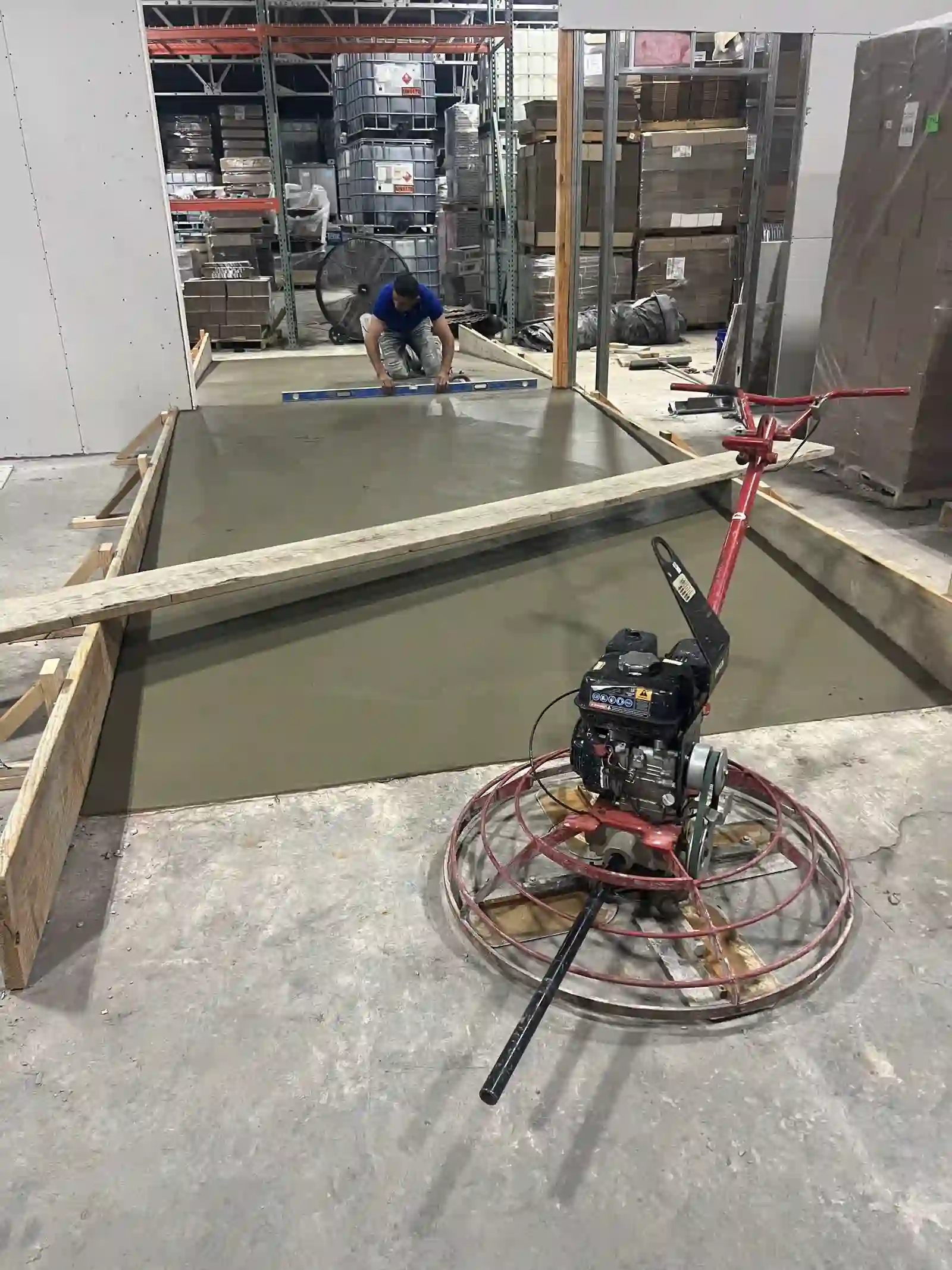
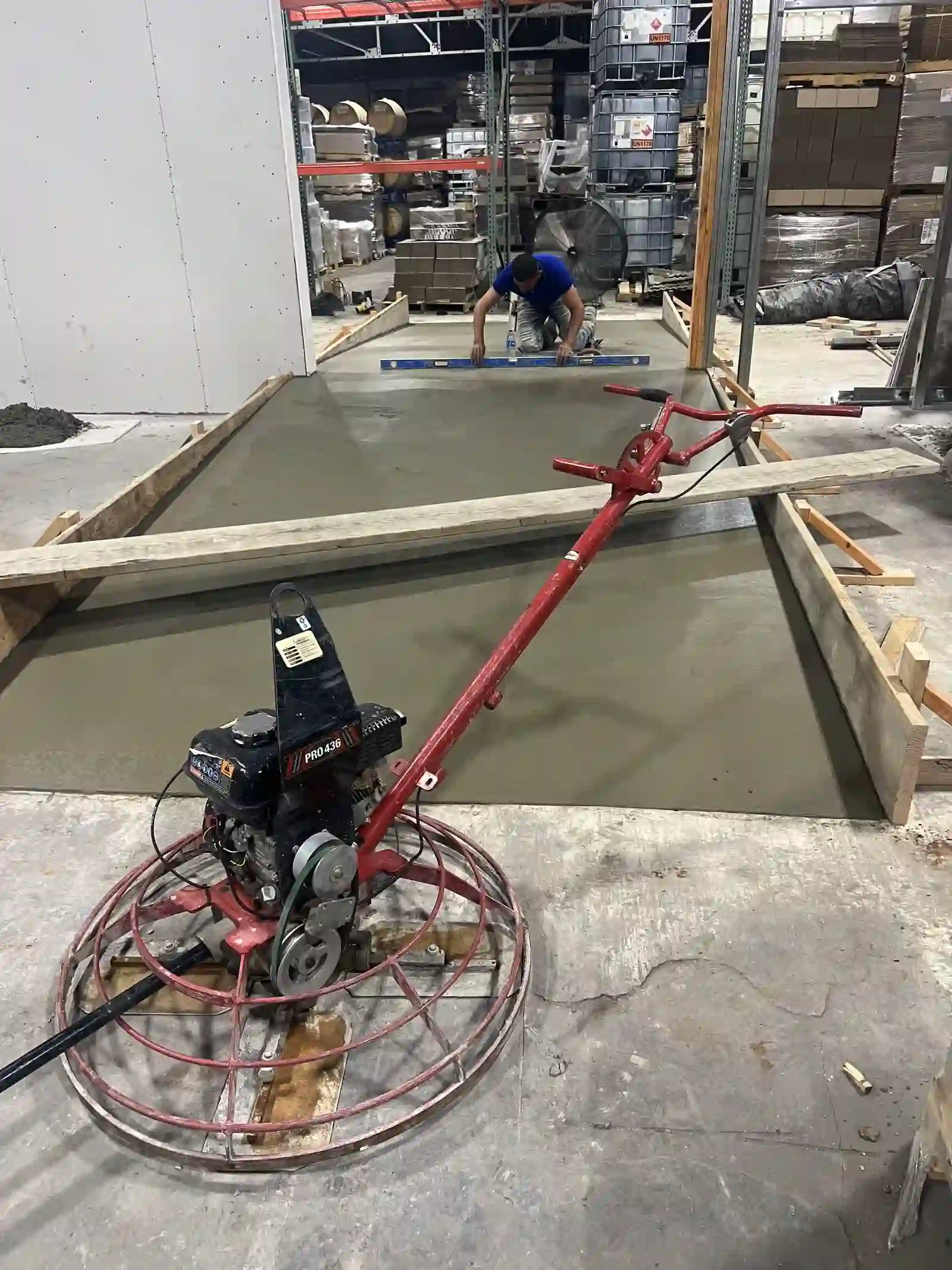
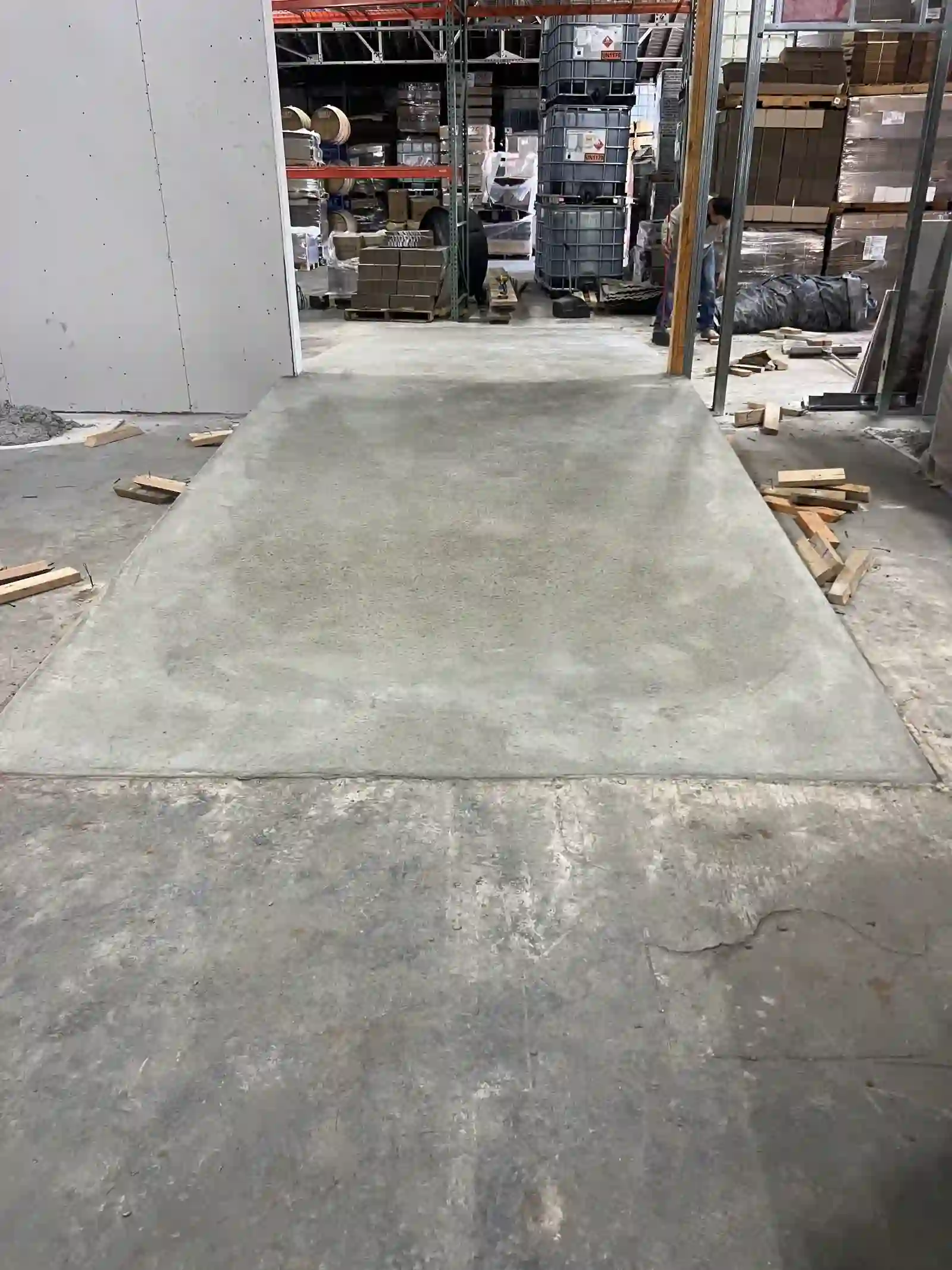
A concrete forklift ramp poured inside a live warehouse in Guthrie, Oklahoma — occupied-facility industrial floor work with the same access and traffic constraints that show up on industrial repair scopes. More photos are on our projects page.
Frequently Asked Questions
- How quickly can industrial concrete be repaired?
- Timing depends on the repair method, materials, temperature, and the traffic you need to restore. Some surface repairs can reopen faster than full-depth panels, which need more cure time before forklift loads. FDZ coordinates return-to-service with your operations after the method is selected — we do not promise a fixed reopen window for every repair.
- Can forklift-damaged concrete be repaired without full replacement?
- Often yes. Joint spalling and localized edge breakout are frequently repairable when the surrounding slab and base are still sound. Full replacement or large panel work is warranted when the sub-base has failed, cracking is widespread, or the floor flexes under load. We evaluate before recommending.
- What causes loading dock concrete to spall?
- Dock face and apron spalling commonly comes from repeated trailer or forklift impact combined with moisture and freeze-thaw cycling. Quality repair addresses the damaged concrete and the conditions that let water keep attacking the surface — not only a cosmetic fill.
- How long do industrial concrete repairs last?
- Longevity depends on prep quality, materials matched to traffic and exposure, whether the underlying cause (joints, moisture, base) was addressed, and how the floor is used afterward. We scope repairs to last under the conditions we see; we do not quote a universal lifespan for every repair type.
- Can repairs be done while the facility is operating?
- Yes. Many industrial repairs can be sequenced by aisle, dock, or zone — including nights or weekends when the site requires it. Call (405) 458-4805 to discuss access and scheduling constraints.
- How do I know if my industrial floor needs repair or full replacement?
- Localized joint failure, surface spalling, and isolated cracked panels are often repair candidates. Widespread structural cracking, floor bounce or flex under load, or broad sub-base failure typically point toward larger replacement. FDZ evaluates the visible conditions and recommends accordingly.
- Is industrial concrete repair different from commercial concrete repair?
- Yes in intent. Industrial repair focuses on operational floors — forklift traffic, joint failure, warehouse and manufacturing damage, and phased work inside active facilities. Commercial concrete repair covers broader property flatwork such as parking lots, sidewalks, trip hazards, and general commercial slabs. Both pages link to each other when the scope crosses that line.
- How do I schedule an industrial concrete repair estimate?
- Call (405) 458-4805 or use the estimate form. Include facility type, location, affected area, problem description, photos, and any downtime or access limits. We follow up to schedule a site visit when one is needed for an accurate written estimate.
Free estimate: Estimate form · (405) 458-4805 · Email FDZ Construction
FDZ Construction LLC is licensed, bonded, and insured in Oklahoma — 8+ years of experience serving the OKC metro, and every project is backed by a 2-year workmanship warranty.